Book your demo
ScriptRunner Connect logo consisting of a pink circle with a white letter C inside

ScriptRunner Connect: Custom triggers

Choose from event-based triggers, manually triggering an integration script or time-based scheduled triggers.
A location dot on a map with Confluence behind it

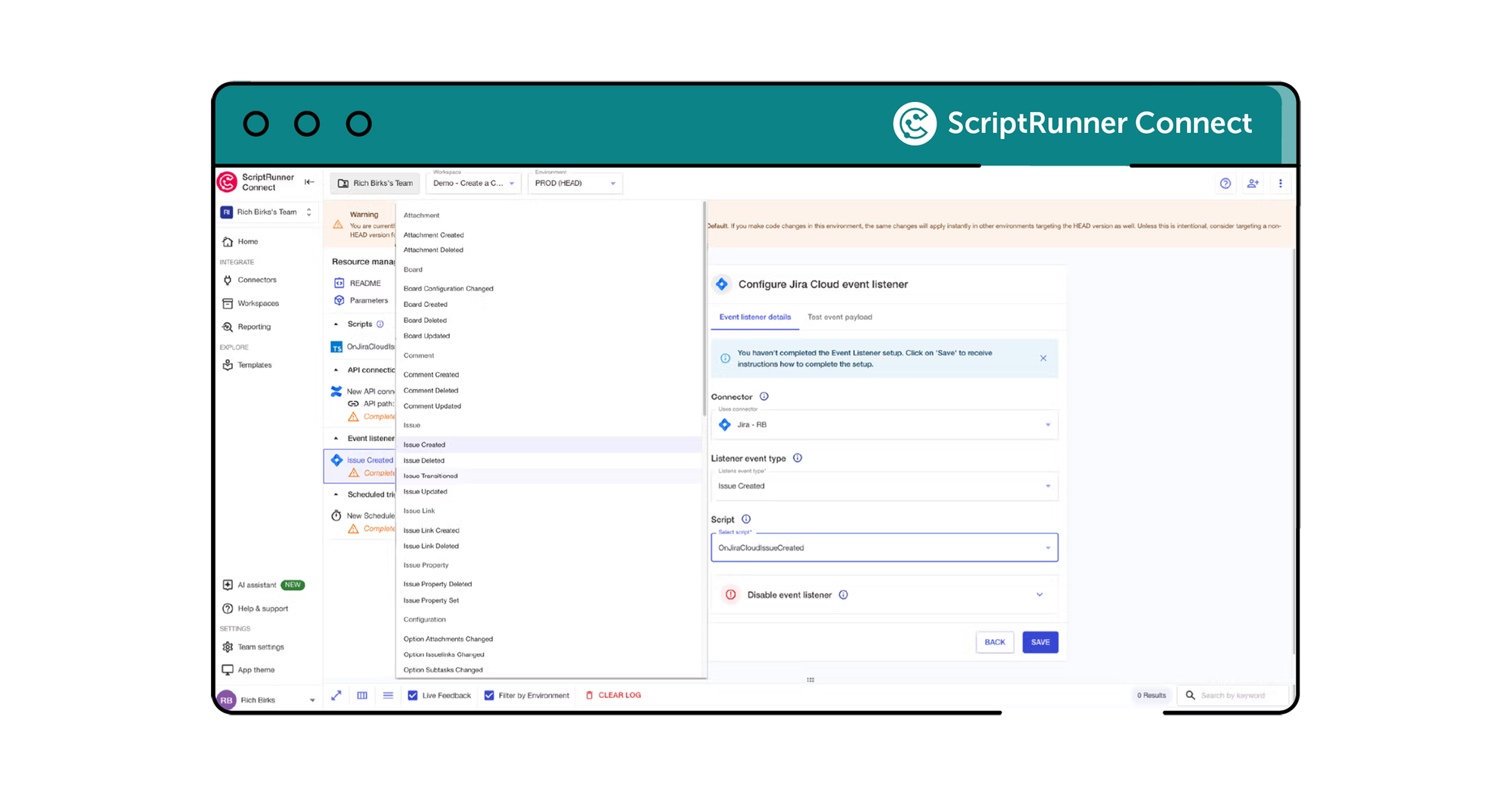
Event-based, reactive triggers

Reactive triggers, or event listeners, allow you to listen and react to events within an app in order to automate the communication between two or more applications. Add and visualise all the triggers within an integration in your workspace. Examples of event types for Jira Cloud are: Issue created, issue updated, user deleted, worklog updated among others.
A view of how a user can set up an event listener in ScriptRunner Connect

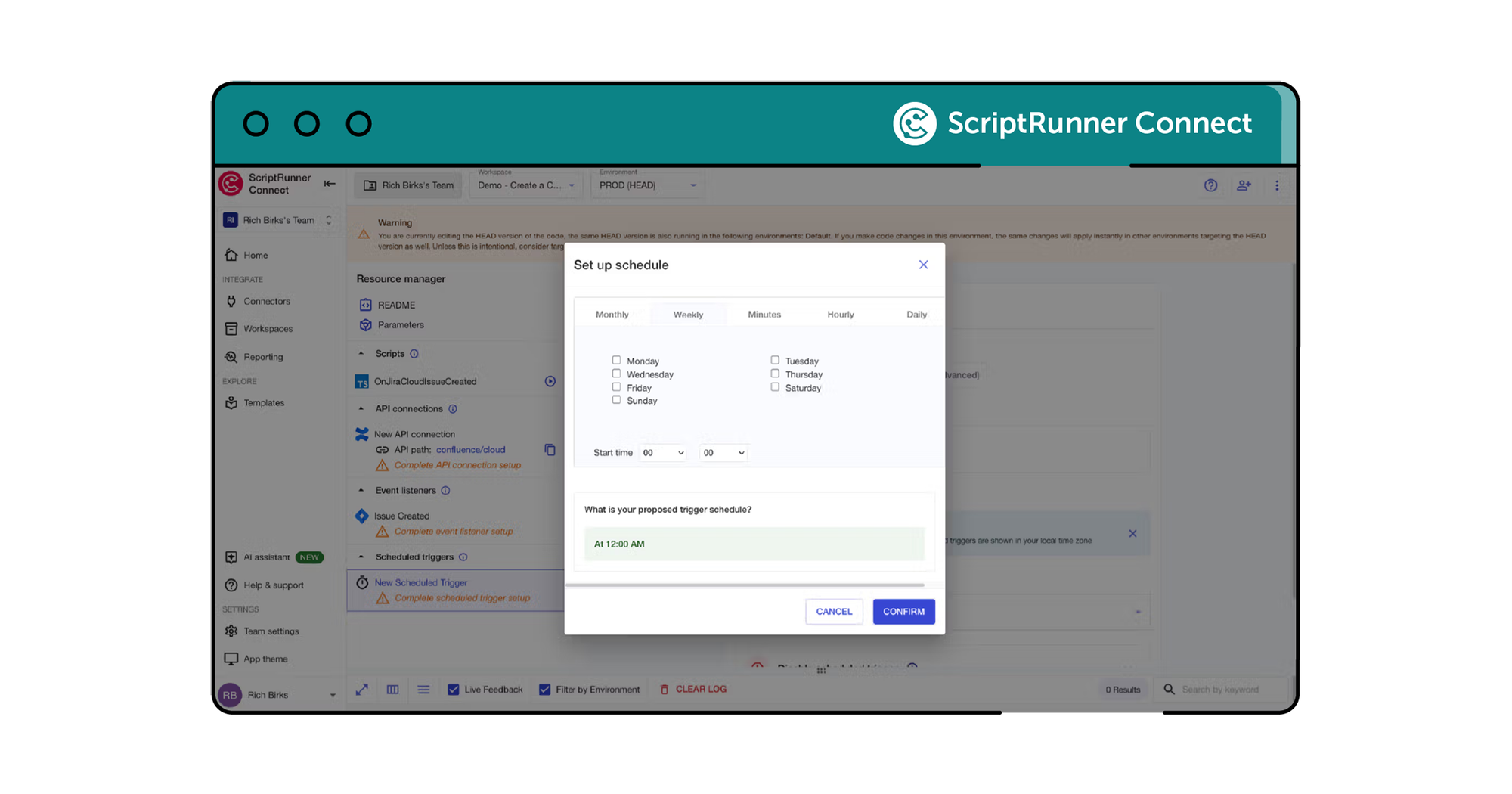
Manual and time-based Scheduled triggers

Scheduled triggers allow you to trigger scripts on a schedule, as opposed to triggering them manually by clicking on the play button next to a script in-app. Control how often a script is run with the option to run your scripts monthly, weekly, daily, hourly, every specified amount of minutes or in real-time—to align script runs with your specific requirements.
A view of how a user can schedule an event in ScriptRunner Connect

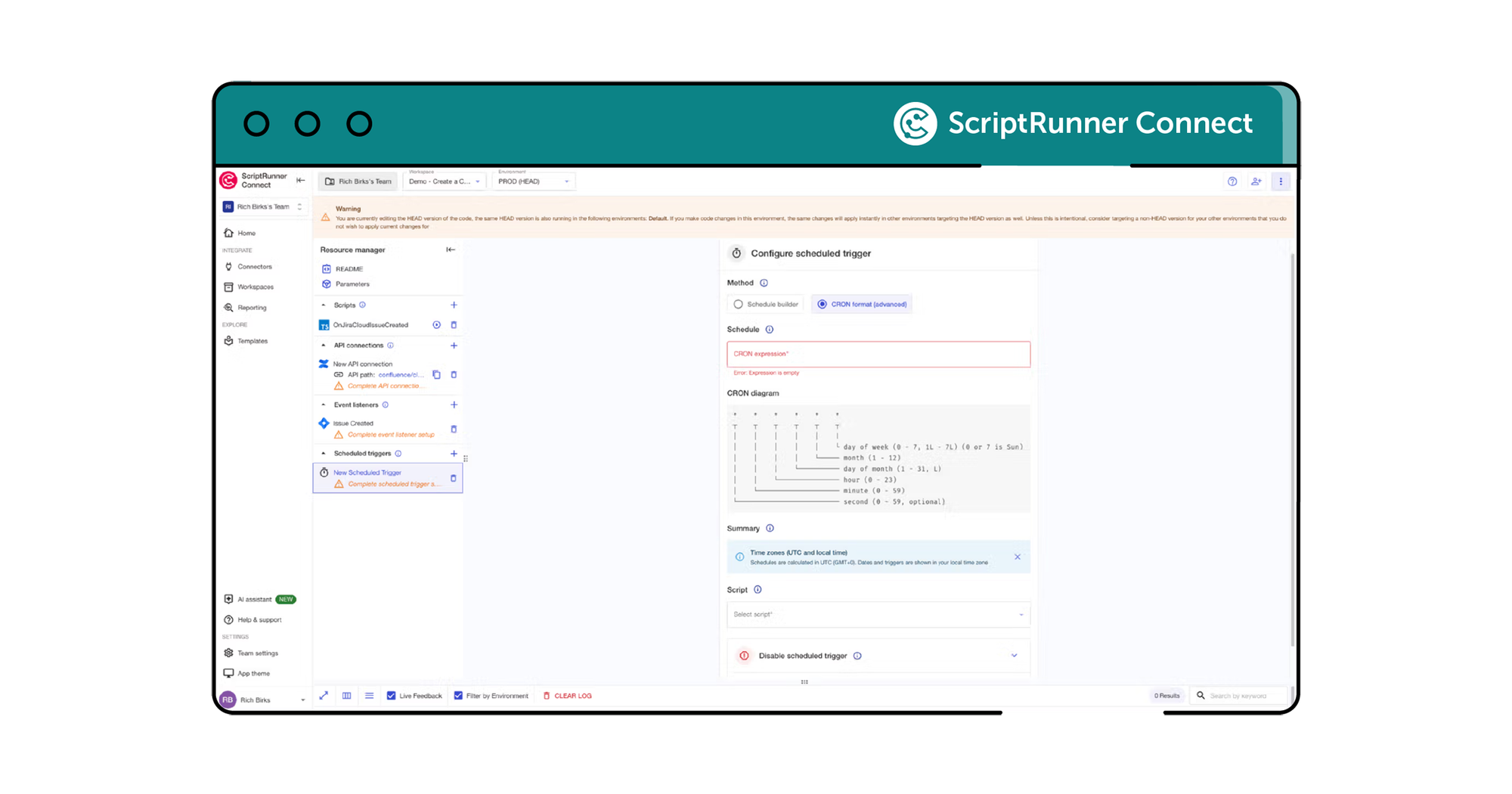
Managing your triggers

Scheduled triggers are set up using Cron format, which is well-suited for scheduling repetitive tasks and ScriptRunner Connect’s UI assists you with this process. Cron can schedule tasks down to the minute, ensuring that tasks are carried out exactly when needed offering you great flexibility, for example scheduling a script during off-peak hours.
A view of how a user can configure scheduled triggers using the CRON format in ScriptRunner Connect

Meet your Customer Success Team

Get a custom, private demo from one of our integration experts so you can chat freely about your specific challenges!

More where that came from

ScriptRunner Connect is filled with rich features to help teams like yours build your best-ever integrations.
A pink box with a left arrow, forward slash and right arrow inside, with grey coloured stars to the top right - to symbolise a code environment supported by AI

Remote workspace (NEW)

Build and manage integrations from your own development environment.
Learn more
A lamp in front of a computer screen to illustrate a workspace

Workspaces

Use workspaces for building, managing, and collaborating on your integrations.
Learn more
A book on a web page to illustrate a template

Templates

Kickstart integrations with pre-built templates for common automation, synchronisation, and migration use cases.
Learn more
A cog in front of a cloud to illustrate a managed API

Managed API

Making coding easier for an awesome developer experience.
Learn more
Two parts of a plug about to connect in front of a cog to illustrate a connector

Connectors

Manage integrations with pre-built Connectors and a Generic Connector for secure and automated authentication.
Learn more
A pink squiggle or lightning flash in the middle of a green circle to signify the AI Assistant

AI assistant

Generate scripts, learn the product's full capabilities and find relevant out-of-the-box use case templates.
Learn more
A group of three people

Teams

Collaborate in shared workspaces to align on integrations for a faster time-to-value.
Learn more
A teal shield icon with a cloud inside it

Private cloud hosting

Run ScriptRunner Connect in your isolated AWS environment for maximum security.
Learn more
A group of three multi-coloured stars

US data residency

AWS-powered infrastructure for enterprise-grade security, reliability and performance.
Learn more
A cog on a shield shape to illustrate security

Security

Rely on the expertise and security-first credentials of the teams behind ScriptRunner.
Learn more

Sound like what you need?